A

AgentMail

Gives AI agents inboxes so they can send and act on email.

No ratings yet|349

From $0/month

On this page

What is AgentMail?

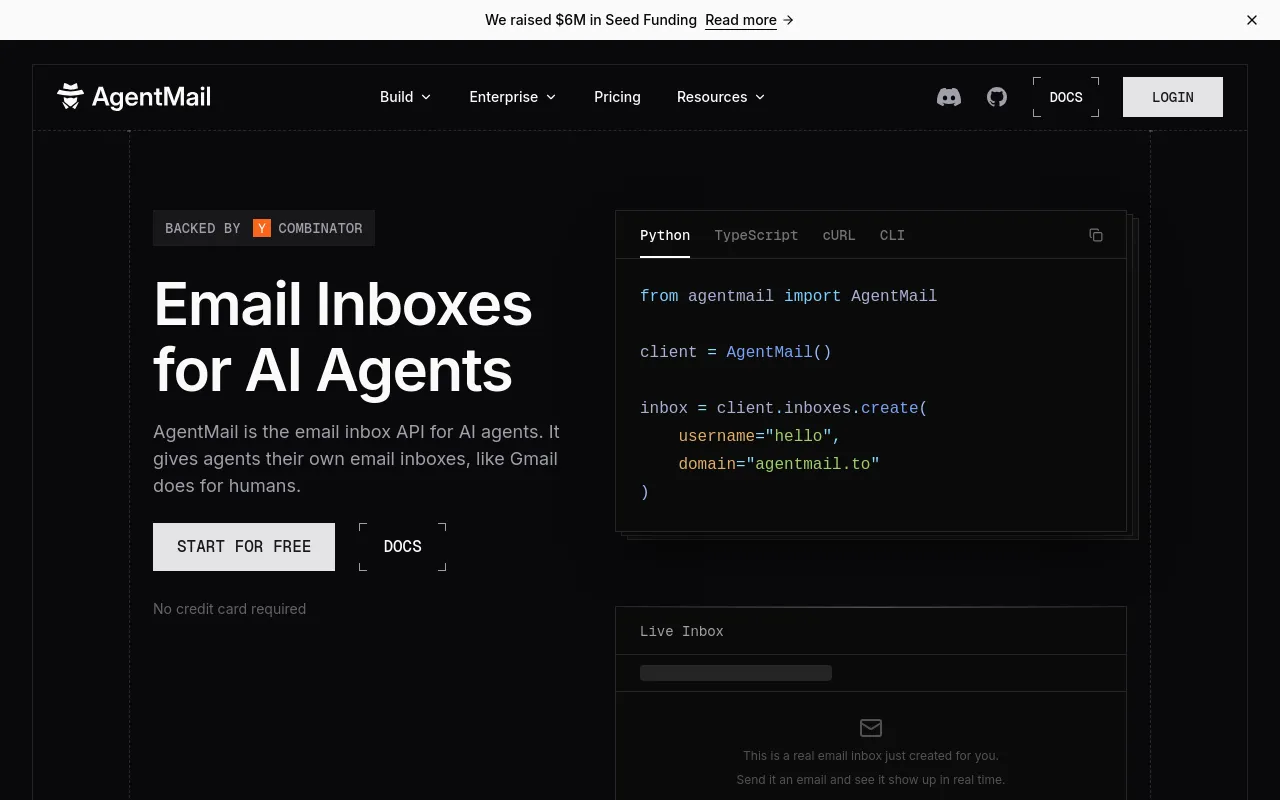
AgentMail is an API platform — "the email inbox API for AI agents" — that gives AI agents their own email inboxes, so they can send, receive, and act on email autonomously, using email as a "universal protocol" to communicate with services, people, and other agents rather than relying on a human-owned mailbox. Agents can use these inboxes to sign up for services, receive confirmations, and authenticate under their own identity.

The platform is built around a programmatic Inbox REST API with full message threading, custom domains configured with DKIM, SPF, and DMARC, webhooks and WebSockets for real-time events, official Python and TypeScript SDKs, an MCP server for AI tool integration, and IMAP/SMTP access. It also offers multi-tenant "Pods," aimed at platform builders who need to provision inboxes for many end users or agents at once.

Core Features

Programmatic Inbox API

Create and manage email inboxes via a REST API, with full message threading support.
Webhooks & WebSockets

Real-time event delivery when mail arrives, instead of polling an inbox.

Custom Domains

Send from your own domain with DKIM, SPF, and DMARC configured.

Python & TypeScript SDKs + MCP Server

Official SDKs for both languages, plus an MCP server so MCP-compatible AI clients can use AgentMail as a tool.

Multi-tenant Pods

Built for platform builders who need to provision and manage inboxes across many end users or tenants.

IMAP & SMTP Access

Standard mail-protocol access for tools that expect IMAP/SMTP rather than a REST API.

How to Use AgentMail

AgentMail's docs describe two setup paths.

For an agent to onboard itself:

  1. The agent registers itself by calling the sign-up endpoint with a human's email and a username, and gets back an API key, inbox ID, and organization ID.
  2. The human checks their email for a 6-digit OTP code, and the agent verifies it to unlock full permissions.
  3. The agent creates an inbox (POST /inboxes, with an optional client_id for idempotent retries) and sends mail (POST /inboxes/<inbox_id>/messages/send with to, subject, and text).

For a human developer integrating AgentMail:

  1. Create an account in the AgentMail Console and generate an API key.
  2. Add the key to a .env file.
  3. Install the SDK — pip install agentmail python-dotenv (Python) or npm install agentmail dotenv (Node/TypeScript).
  4. Initialize the client (AgentMail(api_key=...) in Python or AgentMailClient({ apiKey }) in TypeScript), then call inboxes.create() to create an inbox and inboxes.messages.send() to send a message.

Beyond the REST API and SDKs, AgentMail also exposes an MCP server for MCP-compatible AI clients, and supports IMAP/SMTP for tools built around standard mail protocols.

Use Cases

  • Giving an AI agent its own persistent email identity so it can sign up for third-party services, receive confirmation emails, and complete email-based authentication on its own.
  • Letting agents communicate with people, services, and other agents by email as a "universal protocol," without a human relaying messages.
  • Platform builders provisioning and managing inboxes for many end users or tenants at once, via the multi-tenant "Pods" feature.
  • Getting real-time notification when mail arrives via webhooks or WebSockets, instead of polling an inbox.
  • Sending under a company's own domain with DKIM/SPF/DMARC configured, or integrating via SMTP/IMAP for tools built around standard mail protocols.

Pros & Cons

Pros

  • Agents can onboard themselves end-to-end — self-register via the sign-up endpoint, verify a human's email with a one-time OTP code, and get back an API key and inbox in one flow, without a person manually provisioning the mailbox
  • The Free tier is usable for real testing (3 inboxes, 3,000 emails/month, 100/day) with no credit card required, and includes most core capabilities — threading, labels, webhooks, SDKs, MCP server, and DKIM/SPF/DMARC support — rather than gating them all to paid tiers
  • Supports four different integration paths — REST API, Python/TypeScript SDKs, an MCP server, and IMAP/SMTP — so it can fit agent frameworks and traditional mail tooling alike

Cons

  • There's a 10x price jump between Developer ($20/month, 10 inboxes) and Startup ($200/month, 150 inboxes) with no plan in between, so a team that outgrows Developer but doesn't need 150 inboxes has to jump straight to $200/month
  • Enterprise-grade options (white-label platform, bring-your-own-cloud, EU region hosting, dedicated IPs, SSO) are only available on custom Enterprise pricing, not disclosed publicly
  • No public information about the company itself (founding year, team, funding, headquarters) is available on the marketing site — confirmed by checking the homepage, pricing, enterprise, and docs pages; there's no dedicated About page (returns 404)

Pricing

Free

$0/month

  • 3 inboxes
  • 3,000 emails/month
  • 100 emails/day limit
  • 3GB storage
  • Threading, labels, attachments, drafts, scheduled send
  • SDKs (Python & TypeScript), MCP Server, Inbox Pods
  • Webhooks, WebSockets, metrics
  • SMTP relay, DKIM/SPF/DMARC, suppression lists, shared IP
  • No credit card required

Developer

$20/month

  • 10 inboxes
  • 10,000 emails/month
  • 1,000 emails/day limit
  • 100 emails per 5-minute limit
  • 10GB storage
  • 10 custom domains
  • 2 organization seats
  • Everything in Free, plus email support

Startup

$200/month

  • 150 inboxes
  • 150,000 emails/month
  • 15,000 emails/day limit
  • 1,500 emails per 5-minute limit
  • 150GB storage
  • 150 custom domains
  • 10 organization seats
  • Everything in Developer, plus a SOC 2 report
  • Early-stage startups can apply for a free first month

Enterprise

Custom pricing

  • Unlimited inboxes
  • Bulk discounts
  • Everything in Startup, plus:
  • White-label platform
  • Usage-based pricing option
  • EU region hosting
  • Bring-your-own-cloud deployment
  • Dedicated IPs
  • OIDC/SAML SSO
  • SLA

Frequently Asked Questions