Agent Readiness Score
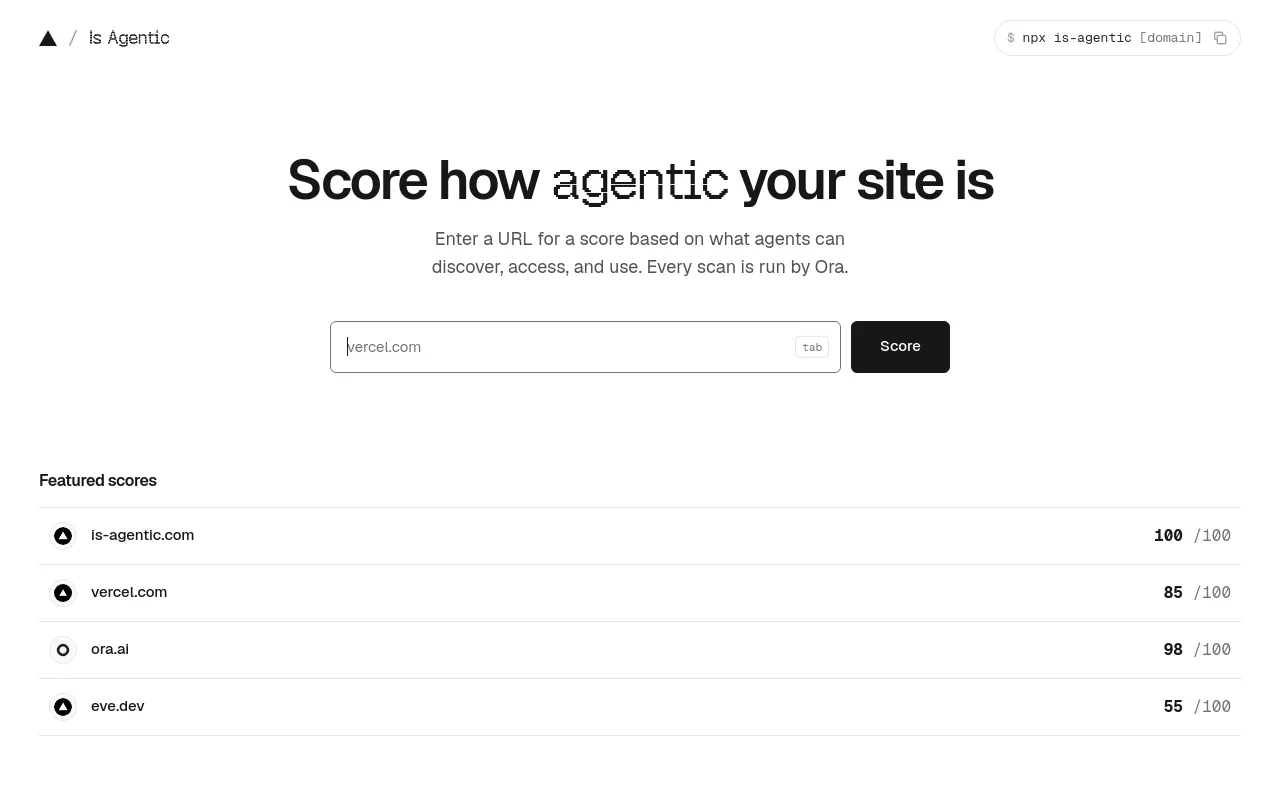
Scans a public URL and returns a 0-100 score based on what AI agents can discover, access, and use on the site.
Alternatives
Manus
Plans, executes, and delivers end-to-end work products.
AgentMail
Gives AI agents inboxes so they can send and act on email.
styleX
StyleX combines the strengths and avoids the weaknesses of both inline styles and static CSS
Grok Bot
Always-on AI teammates that get their own cloud computer, sign into your tools, and finish multi-step work on their own.
Is Agentic is a free tool built by Vercel on top of Ora's agent-readiness scoring engine. Enter any public URL and it scans what AI agents can discover, access, and understand on that site, then returns a 0-100 score plus a detailed report.
The score is applicability-aware: Essential checks (server-rendered content, correct HTTP behavior, clear document structure, recoverable errors, usable controls) carry most of the weight and apply to every site. Recommended checks only activate when a site actually offers an API, OAuth flow, GraphQL endpoint, MCP server, developer portal, or commerce surface — sites without those interfaces aren't penalized for lacking them. Emerging formats (like llms.txt) can add a small bonus but never lower a score if absent.
Each report also includes an observed agent journey — a real run showing how an agent navigated the site and where it hit friction — plus concrete, evidence-backed recommendations. Reports are publicly accessible at stable URLs, render server-side (so crawlers don't need JavaScript), and are available as Markdown or structured JSON, with a companion MCP server for programmatic retrieval. Is Agentic is powered by Ora and operated by Vercel.
Scans a public URL and returns a 0-100 score based on what AI agents can discover, access, and use on the site.
Applicability-aware scoring: universal Essential checks, Recommended checks that only apply when relevant interfaces exist (API, OAuth, GraphQL, MCP, commerce), and small Emerging-format bonuses that never penalize absence.
Every check includes the evidence observed during the scan and, where applicable, a concrete fix that can be copied into an implementation workflow.
Each report shows a real agent's navigation path through the site and where it encountered friction, as supporting evidence alongside the numeric score.
Reports render as server-side HTML by default, are available as compact Markdown for agent consumption, and as structured JSON via a public API.
A read-only MCP server exposes completed reports as a tool with a declared schema, for use from MCP-compatible clients — no credentials or scan-triggering required.
Each report lives at a persistent per-domain URL; rescanning replaces it with a fresh snapshot while keeping the same shareable link.
$0