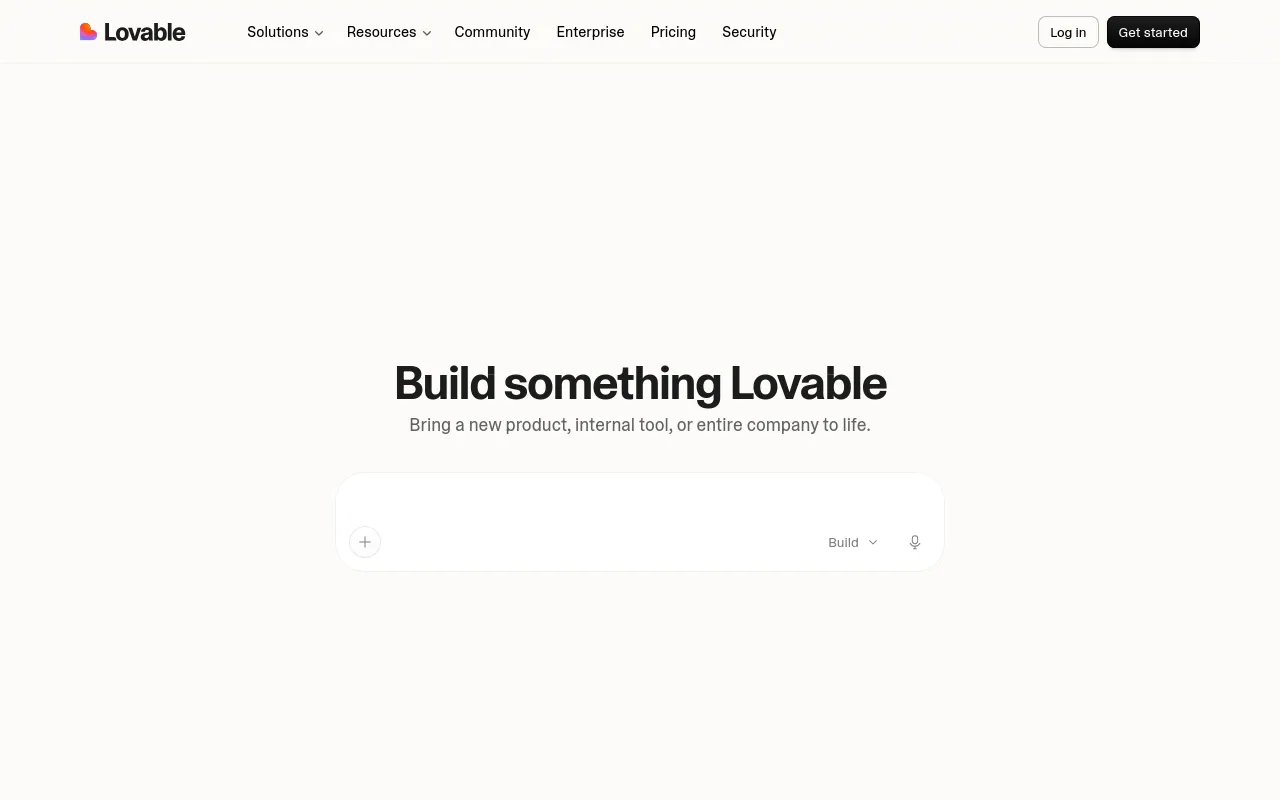
Bring a new product, internal tool, or entire company to life.

No ratings yet|8

From $0

On this page

What is Lovable?

Lovable is an AI app builder — often described as a "vibe coding" platform — that generates full-stack Next.js web applications from natural-language prompts, letting people build real, deployable apps and websites by chatting with AI rather than writing code by hand. It grew out of founder Anton Osika's 2023 open-source GPT Engineer project, was commercialized as the GPT Engineer App, and rebranded as Lovable in December 2024 ahead of its public launch. The company was founded in 2023 in Stockholm, Sweden, by Anton Osika (CEO) and Fabian Hedin.

Lovable's growth has been extremely fast: a $200 million Series A at a $1.8 billion valuation in February 2025, a $330 million Series B at $6.6 billion in December 2025, and a $400 million Series C led by Menlo Ventures and EQT's Scaleup Europe Fund at a $13.3 billion valuation on August 12, 2026, with the company reportedly approaching a $600 million annualized revenue run rate by the end of that month. As of August 2026, Lovable said its platform hosted 60 million projects with 900 million monthly visitors combined.

Inside a project, Lovable offers three main modes: Agent/Chat mode for prompting the AI to build or change something, Visual Edits for click-to-edit changes directly on the rendered page, and Code mode for hand-editing files in the browser. Plan Mode (introduced February 2026) shows a detailed plan of what the AI intends to build before it writes any code, and Agent Mode adds autonomous multi-step execution, which the company says has reduced errors by 91% since launch. Supabase 2.0 is the default backend integration, providing database, authentication, storage, edge functions, and automatic log debugging out of the box.

Core Features

Natural-Language App Generation

Generates a full-stack Next.js web application directly from a plain-language prompt, without requiring the user to write code.
Plan Mode

Shows a detailed plan of what the AI intends to build before writing any code, introduced February 2026.

Agent Mode

Autonomous multi-step execution of a build or change, reported by the company to have cut errors by 91% since launch.

Visual Edits

Click-to-edit changes made directly on the rendered page, for non-technical, pixel-level adjustments.

Code Mode

Lets developers hand-edit the generated application's underlying files directly in the browser.

Supabase 2.0 Integration

The default backend: database, authentication, storage, edge functions, and automatic log debugging, set up out of the box.

How to Use Lovable

  1. Sign up at lovable.dev — the Free plan requires no payment and includes daily and monthly credit grants to try the product.
  2. Describe the app or website you want to build in plain language; Lovable's Agent/Chat mode plans and generates a full-stack Next.js application from the prompt.
  3. Turn on Plan Mode to review a detailed plan of what the AI intends to build before any code is written, or let Agent Mode run autonomously through multi-step changes.
  4. Refine the result with Visual Edits — click directly on the rendered page to change text, layout, or styling — or switch to Code mode to hand-edit the underlying files in the browser.
  5. Connect Supabase (the default backend integration) for database, authentication, storage, and edge functions, with automatic log debugging when something breaks.
  6. Deploy the finished app directly from Lovable, and upgrade from Free to Pro, Business, or Enterprise as your monthly credit usage and team/security needs grow.

Use Cases

  • Turning a plain-language description into a deployable full-stack web app, without writing code by hand.
  • Rapid prototyping of a product idea, internal tool, or MVP to validate before committing engineering resources.
  • Non-technical founders, designers, and product managers building and shipping their own apps directly, using Visual Edits for pixel-level changes without touching code.
  • Developers who want to hand-edit generated code directly in the browser via Code mode, rather than treating the AI output as a black box.
  • Apps that need a backend quickly — database, auth, storage, and edge functions — via the default Supabase 2.0 integration, without configuring that infrastructure manually.
  • Teams and organizations that need SSO, a security center, or volume-based pricing for larger-scale or higher-governance deployments (Business and Enterprise plans).

Pros & Cons

Pros

  • Plan Mode lets you review what the AI intends to build before it writes any code, and Agent Mode's autonomous multi-step execution is reported to have cut errors by 91% since launch — real guardrails rather than a pure black-box generation loop
  • Three distinct editing modes in one project (Agent/Chat, Visual Edits, Code) mean both non-technical builders and developers can work in the mode that suits them, on the same underlying app
  • Supabase 2.0 is wired in as the default backend, so database, auth, storage, and edge functions come set up out of the box instead of requiring separate backend configuration
  • Extremely well-capitalized and fast-growing (a $13.3 billion valuation as of its August 2026 Series C, up from $1.8 billion 18 months earlier), suggesting strong momentum and continued investment in the product

Cons

  • Credit-based pricing (5 daily + roughly 100 monthly credits on Pro, for example) means actual monthly cost scales with usage in a way that's less predictable than a flat subscription, and heavier users may need to buy additional credit allowances
  • Business (~$50/month) is needed just to get SSO and a security center, which smaller teams that need basic access controls but aren't ready for a full Business-tier spend may find restrictive
  • As a "vibe coding" tool that generates full applications from prompts, output quality depends heavily on prompt clarity and the specific stack choices Lovable makes (Next.js, Supabase by default); teams with strict existing infrastructure requirements should verify compatibility before committing
  • The company has repriced and re-featured quickly across 2026 (Plan Mode, Agent Mode, a credit selector, annual billing changes), so plan details are worth checking against the live pricing page rather than assuming they're static

Pricing

Free

$0

  • 5 daily build credits (up to 30/month)
  • 20 monthly Cloud credits
  • 4 AI feature credits for user apps
  • Good for trying the product

Pro

~$25/month

  • ~100 monthly credits plus daily grants (roughly 250 credits/month total)
  • Credit selector to increase allowance without upgrading tiers
  • Annual billing offers ~2 months free

Business

~$50/month

  • Everything in Pro
  • SSO and a security center
  • Built for teams and larger organizations

Enterprise

Custom (contact sales)

  • Volume-based credit pricing
  • For large organizations

Frequently Asked Questions